Colloid &  Nanoscience  Journal

Colloid & Nanoscience Journal

Synergistic effect of plasmonic Au nanostar and Cu2O/TiO2 heterojunctions toward highly efficient photocatalytic degradation of MB dye under visible light irradiation

Document Type : Original Article

Author
Dipartimento di Chimica "Ugo Schiff" (DICUS) - Università degli Studi di Firenze, Via della Lastruccia, 3, 50019 Sesto Fiorentino FI
Abstract
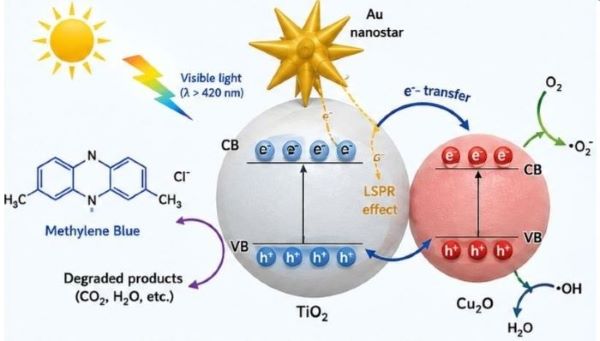
In this study, visible-light-responsive Au nanostar-decorated Cu₂O/TiO₂ ternary nanocomposites were successfully synthesized and evaluated for the photocatalytic degradation of methylene blue (MB). The incorporation of Au nanostars introduced a strong localized surface plasmon resonance (LSPR) effect, enhancing visible-light absorption and promoting photogenerated charge carrier generation. Simultaneously, the Cu₂O/TiO₂ heterojunction, with an estimated band gap of approximately 2.3 eV, facilitated efficient charge separation and extended the optical response into the visible region, as confirmed by diffuse reflectance spectroscopy (DRS). Dynamic light scattering (DLS), zeta potential, and X-ray diffraction (XRD) analyses confirmed the formation of a well-dispersed, crystalline, and colloidally stable ternary nanocomposite. The enhanced photocatalytic activity was attributed to the synergistic effects of plasmon-induced light harvesting, efficient interfacial charge transfer, and suppressed electron–hole recombination, leading to increased generation of reactive oxygen species (•OH and O₂•⁻). The effects of Au nanostar loading and photocatalyst dosage were systematically investigated, revealing optimum performance at intermediate loading levels, while excessive loading reduced efficiency because of active-site shielding and light scattering. Under optimized conditions, the photocatalyst achieved approximately 97% degradation of methylene blue within 90 min under visible-light irradiation and retained approximately 84% of its initial activity after ten reuse cycles. These results demonstrate the potential of the Au nanostar/Cu₂O/TiO₂ nanocomposite as an efficient and reusable visible-light-driven photocatalyst for wastewater treatment.

Graphical Abstract

Synergistic effect of plasmonic Au nanostar and Cu2O/TiO2 heterojunctions toward highly efficient photocatalytic degradation of MB dye under visible light irradiation
Keywords

[1] D.A. Yaseen, M. Scholz, Textile dye wastewater characteristics and constituents of synthetic effluents: a critical review, Int. J. Environ. Sci. Technol. 16 (2019) 1193–1226. https://doi.org/10.1007/s13762-018-2130-z
[2] R. Kant, Textile dyeing industry an environmental hazard, Nat. Sci. 4 (2012) 22–26. 
https://doi.org/10.4236/ns.2012.41004
[3] T. Robinson, G. McMullan, R. Marchant, P. Nigam, Remediation of dyes in textile effluent: a critical review on current treatment technologies with a proposed alternative, Bioresour. Technol. 77 (2001) 247–255. 
https://doi.org/10.1016/S0960-8524(00)00080-8
[4] G. Crini, E. Lichtfouse, Advantages and disadvantages of techniques used for wastewater treatment, Environ. Chem. Lett. 17 (2019) 145–155. 
https://doi.org/10.1007/s10311-018-0785-9
[5] E. Forgacs, T. Cserháti, G. Oros, Removal of synthetic dyes from wastewaters: a review, Environ. Int. 30 (2004) 953–971. 
https://doi.org/10.1016/j.envint.2004.02.001
[6] M.N. Chong, B. Jin, C.W.K. Chow, C. Saint, Recent developments in photocatalytic water treatment technology: a review, Water Res. 44 (2010) 2997–3027. 
https://doi.org/10.1016/j.watres.2010.02.039
[7] A. Fujishima, X. Zhang, D.A. Tryk, TiO
photocatalysis and related surface phenomena, Surf. Sci. Rep. 63 (2008) 515–582. https://doi.org/10.1016/j.surfrep.2008.10.001
[8] A. Fujishima, K. Honda, Electrochemical photolysis of water at a semiconductor electrode, Nature 238 (1972) 37–38. 
https://doi.org/10.1038/238037a0
[9] J. Saien, F. Ghamari, A. Azizi, The role of counter-anions in photocatalytic reduction of Ni(II) with a trace amount of titania nanoparticles. J. IRAN CHEM. SOC. 13 (2016) 2247–2255 (2016). https://doi.org/10.1007/s13738-016-0943-6
[10] X. Chen, S.S. Mao, Titanium dioxide nanomaterials: synthesis, properties, modifications, and applications, Chem. Rev. 107 (2007) 2891–2959. https://doi.org/10.1021/cr0500535
[11] M.R. Hoffmann, S.T. Martin, W. Choi, D.W. Bahnemann, Environmental applications of semiconductor photocatalysis, Chem. Rev. 95 (1995) 69–96. 
https://doi.org/10.1021/cr00033a004
[12] A. Paracchino, V. Laporte, K. Sivula, M. Grätzel, E. Thimsen, Highly active oxide photocathode for photoelectrochemical water reduction, Nat. Mater. 10 (2011) 456–461. 
https://doi.org/10.1038/nmat3017
[13] W. Wang, M.O. Tadé, Z. Shao, Research progress of perovskite materials in photocatalysis- and photovoltaics-related energy conversion and environmental treatment, Chem. Soc. Rev. 47 (2018) 2614–2632. 
https://doi.org/10.1039/C7CS00578H
[14] Z. Zhang, P. Wang, Highly stable copper oxide composite as an effective photocathode for water splitting via a facile electrochemical synthesis strategy, J. Mater. Chem. 22 (2012) 2456–2464. 
https://doi.org/10.1039/C1JM14501K
[15] H. Xu, S. Ouyang, L. Liu, P. Reunchan, N. Umezawa, J. Ye, Recent advances in TiO
-based photocatalysis, Appl. Catal. B Environ. 180 (2016) 591–598. https://doi.org/10.1016/j.apcatb.2015.06.067
[18] Z. Shao, Y. Zhang, X. Yang, M. Zhong, Au-mediated charge transfer process of ternary Cu
O/Au/TiO nanoheterostructures for improved photoelectrochemical performance, ACS Omega 5 (2020) 7503–7518. https://doi.org/10.1021/acsomega.0c00299
[19] J.Y. Lee, J.H. Choi, Fabrication of a Cu
O-Au-TiO heterostructure with improved photocatalytic performance for the abatement of hazardous toluene and α-pinene vapors, Catalysts 10 (2020) 1434. https://doi.org/10.3390/catal10121434
[20] H. Yuan, C.G. Khoury, C.M. Wilson, G.A. Grant, A.J. Bennett, T. Vo-Dinh, In vivo particle tracking and photothermal ablation using plasmon-resonant gold nanostars, Nanotechnology 23 (2012) 075102. 
https://doi.org/10.1088/0957-4484/23/7/075102
[21] M.R. Langille, M.L. Personick, J. Zhang, C.A. Mirkin, Defining rules for the shape evolution of gold nanoparticles, J. Am. Chem. Soc. 134 (2012) 14542–14554. 
https://doi.org/10.1021/ja305196s
[22] G. Baffou, R. Quidant, Thermo-plasmonics: using metallic nanostructures as nano-sources of heat, Chem. Soc. Rev. 43 (2014) 3898–3907. 
https://doi.org/10.1039/C3CS60364D
[23] Y. Tai, B. Yang, J. Li, L. Meng, P. Xing, S. Wang, Design and preparation of heterostructured CuO/TiO materials for photocatalytic applications, Molecules 29 (2024) 5028. https://doi.org/10.3390/molecules29215028
[24] M. Fariza, A. Norazlina, T. Azman, M.K. Ahmad, K. Murakami, Properties Enhancement of Cu
O/TiO heterostructure film using two-step hydrothermal and potentiostatic deposition method, Int. J. Nanoelectron. Mater. 17 (2024) 7–12. https://doi.org/10.58915/ijneam.v17iJune.820
[25] Y. Zhang et al., Cu
O/TiO Heterojunction for photoelectrochemical applications, Surf. Interfaces 37 (2023) 102751. https://doi.org/10.1016/j.surfin.2023.102751
[26] Li, X.; Zhang, H.; et al., Plasmonic gold nanostars for enhanced photocatalysis, ACS Nano 17 (2023) 11234–11245. https://doi.org/10.1021/acsnano.3c01234
[27] Chen, Y.; Wang, J.; et al., Seed-mediated synthesis of Au nanostars with tunable LSPR properties, Chem. Eng. J. 452 (2023) 139234. 
https://doi.org/10.1016/j.cej.2022.139234
[28] Zhou, L.; et al., Plasmon-enhanced CuO/TiO photocatalysts decorated with noble metals, Appl. Surf. Sci. 615 (2024) 156324. https://doi.org/10.1016/j.apsusc.2023.156324
[29] P. Qiao, X. Wang, J. Liu, Y. Liu, M. Dai, R. Piao, Y. Liu, W. Wang, Y. Wang, H. Song, Fabrication of Cu
O-loaded TiO nanotubes with heterojunctions via an electrochemical method: enhanced photocatalytic activity, React. Chem. Eng. 8 (2023) 3028–3040. https://doi.org/10.1039/D3RE00226H
[30] M. Danaei, M. Dehghankhold, S. Ataei, F.H. Hasanzadeh Davarani, R. Javanmard, A. Dokhani, S. Khorasani, M.R. Mozafari, Impact of particle size and polydispersity index on the clinical applications of lipidic nanocarrier systems, Pharmaceutics 10 (2018) 57. https://doi.org/10.3390/pharmaceutics10020057
[31] J. Jiang, G. Oberdörster, P. Biswas, Characterization of size, surface charge, and agglomeration state of nanoparticle dispersions for toxicological studies, J. Nanopart. Res. 11 (2009) 77–89. https://doi.org/10.1007/s11051-008-9446-4
[32] Y. Tai, B. Yang, J. Li, L. Meng, P. Xing, S. Wang, Design and preparation of heterostructured CuO/TiO materials for photocatalytic applications, Molecules 29 (2024) 5028. https://doi.org/10.3390/molecules29215028
[33]
J. Lan, X. Zhang, J. Chang, B. Wu, B. Chen, J. Wu, A novel two-step electrochemical method for the complete filling of Cu2O into TiO2 nanotube arrays as an anti-fouling surface for titanium, J. Alloys Compounds, 1016 (2025) 178931. https://doi.org/10.1016/j.jallcom.2025.178931
[34] C. Dallari, C. Capitini, M. Calamai, A. Trabocchi, F.S. Pavone, C. Credi, Gold nanostars bioconjugation for selective targeting and sers detection of biofluids.Nanomaterials, 8(11) (2021) 665. https://doi.org/10.3390/nano11030665.
[35] T. Kong, A. Liao, Y. Xu, X. Qiao, H. Zhang, L. Zhang, C. Zhang, Recent advances and mechanism of plasmonic metal–semiconductor photocatalysis, RSC Adv. 14 (2024) 17041–17050. https://doi.org/10.1039/D4RA02808B
[36] L. Liu, K. Dai, J. Zhang, L. Li, Plasmonic Bi-enhanced ammoniated α-MnS/Bi2MoO6 S-scheme heterostructure for visible-light-driven CO2 reduction. J. Colloid Interface Sci. 15(604) (2021) 844-855. https://doi.org/10.1016/j.jcis.2021.07.064. 
[37]
X. Zheng, R. Piao, X. Wang, P. Qiao, X. Guo, M. Zheng, Y. Liu, Y. Wang, H. Song, Y. Chen, F. Feng, Photocatalytic hydrogen evolution and photodegradation performance of Ag and Cu2O co-decorated TiO2 nanotubes, New J. Chem., 50 (2026) 1430. https://doi.org/10.1039/D5NJ04633E
[38] S.W. Verbruggen, R. Ninakanti, R. Borah, T. Craig, R.-G. Ciocarlan, P. Cool, S. Bals, Au@TiO Core–Shell Nanoparticles with Nanometer-Controlled Shell Thickness for Balancing Stability and Field Enhancement in Plasmon-Enhanced Photocatalysis, ACS Nano 18 (2024) 33430–33440. https://doi.org/10.1021/acsnano.4c09944.
 
[39] Y. Tai, B. Yang, J. Li, L. Meng, P. Xing, S. Wang, Design and preparation of heterostructured CuO/TiO materials for photocatalytic applications, Molecules 29 (2024) 5028. https://doi.org/10.3390/molecules29215028

[40] H. Qian, B. Yuan, Y. Liu, R. Zhu, W. Luan, C. Zhang, Oxygen vacancy enhanced photocatalytic activity of Cu
O/TiO heterojunction, Science 27 (2024) 109578. https://doi.org/10.1016/j.isci.2024.109578

[41] Y. Zhang, J. He, X. Zhang, Au-mediated charge transfer process of ternary Cu
O/Au/TiO nanoheterostructures for improved photoelectrochemical performance, ACS Omega 5 (2020) 10957–10967. https://doi.org/10.1021/acsomega.0c00299
[42] K. Huang, G. Liang, S. Sun, H. Hu, X. Peng, R. Shen, X. Li, Interface-induced charge transfer pathway switching of a CuO–TiO photocatalyst from p–n to S-scheme heterojunction for effective photocatalytic H evolution, J. Mater. Sci. Technol. 193 (2024) 98–106. https://doi.org/10.1016/j.jmst.2024.01.034
 
[43] M. Chong, B. Jin, C.W.K. Chow, C. Saint, Recent developments in photocatalytic water treatment technology, Water Res. 44 (2010) 2997–3027. https://doi.org/10.1016/j.watres.2010.02.039.

[44] R. Verma, G. Sharma, V. Polshettiwar, The paradox of thermal vs. non-thermal effects in plasmonic photocatalysis, Nat. Commun. 15 (2024) 7974. 
https://doi.org/10.1038/s41467-024-51916-3


Volume 4, Issue 1
Winter 2026

  • Receive Date 28 June 2026
  • Revise Date 18 July 2026
  • Accept Date 18 July 2026